
Users vs Contacts: pick the right tool first
Your client portal supports two ways to give other people visibility into your account. They look similar at first glance but serve different needs, and picking the right one upfront avoids confusion later.
| Users | Contacts | |
|---|---|---|
| Has their own login? | Yes | No |
| Can sign in and see things? | Yes (with whatever permissions you grant) | No, they only receive emails |
| Best for | Team members who actively manage hosting (developers, agency staff) | People who only need notifications (a bookkeeper who needs invoice copies) |
| Where to manage | Account Details > User Management | Account Details > Contacts |
This article covers Users (login access). For Contacts (notification-only), see Managing Your Billing Preferences.
The User Management page
From your client portal, click your avatar in the top-right and choose Account Details, then click User Management in the left sidebar:
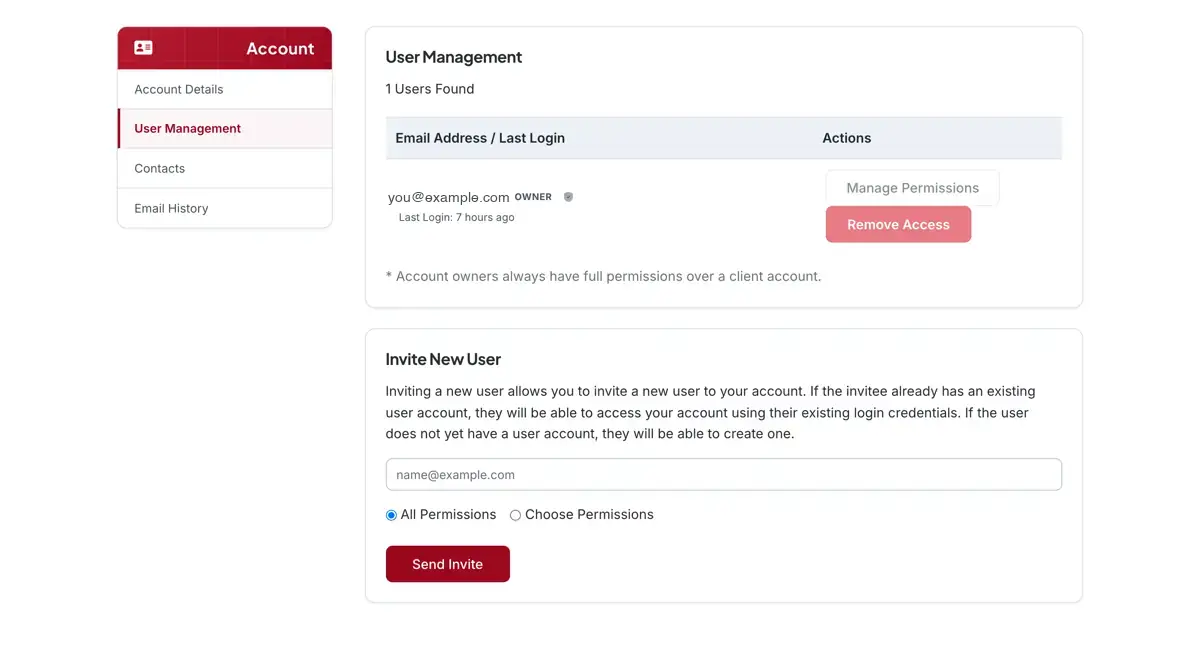
Top: every user with access to your account, plus action buttons for changing permissions or removing access. Bottom: the Invite New User form for adding teammates.
The page has two halves:
- Existing users: a list of everyone with access, their email, last login time, and an OWNER badge on the account holder. Action buttons let you change permissions or remove access.
- Invite New User: a small form for adding a new teammate by email.
Inviting a new user
To give a teammate portal access:
- Type their email address into the Invite New User form.
- Choose All Permissions (full account access, like a co-owner) or Choose Permissions (granular control over what they can do).
- Click Send Invite.
What happens next depends on whether they already have a user account on our portal:
- Existing user: they sign in with their existing email and password and see your account in their list.
- New user: the invite email walks them through creating a password. The invite link is valid for 72 hours.
You can revoke or edit their permissions at any time from this same page.
Permission categories
If you choose Choose Permissions when inviting (or when changing an existing user’s permissions), you grant access to specific areas:
- Modify Master Account Profile: change the main account holder’s contact information.
- View & Manage Contacts: add, edit, or remove notification-only contacts.
- View Products & Services: see hosting plans and their status.
- View & Modify Product Passwords: see and change FTP, database, and email passwords for the services on the account.
- Perform Single Sign-On: use the portal’s pass-through to log into Plesk or WordPress admin without a separate password.
- View Domains and Manage Domain Settings: see and update domains registered or transferred to us.
- Place New Orders/Upgrades: order new hosting plans or upgrade existing services.
- View & Pay Invoices: see billing history and pay outstanding invoices.
- View & Open Support Tickets: file new tickets and read existing conversations.
For most agency or developer relationships, the right combination is: View Products & Services, Modify Product Passwords, Single Sign-On, and View & Open Support Tickets. That lets them do technical work without giving them billing visibility or the ability to place new orders.
Managing existing users
For each user in the list:
- Manage Permissions: change what they can see and do. Useful when a team member’s role changes (e.g., promoting a developer to co-owner, or pulling back access from a contractor whose engagement is ending).
- Remove Access: revoke their access immediately. The user keeps their portal account but no longer sees yours in their list. Use this when a teammate leaves.
The OWNER badge marks the original account holder. Owners always have full permissions and cannot be removed without escalating account ownership transfer through our support team.
Best practices
- Audit quarterly: review the user list every quarter. Remove access for anyone who has left the team or no longer needs it.
- Match permissions to role: a developer rarely needs billing access. A bookkeeper rarely needs technical access. Use the granular permissions to right-size each user.
- Avoid sharing logins: it is tempting to hand the main login to a contractor for a one-off task. Don’t. Invite them as a user with limited permissions, then revoke when the work is done. This preserves an audit trail and prevents lockout if they leave abruptly.
- Two-factor authentication: encourage every user to enable 2FA on their own account. See Securing Your Client Portal Account.
Frequently asked questions
What is the difference between a user and a contact?
A user has their own login and can sign in to perform actions. A contact is just an email address that receives notifications. If they need to do anything in the portal, make them a user. If they only need to see invoice or support emails, make them a contact.
Can a user manage multiple WebOps accounts under one login?
Yes. If they accept invites to multiple accounts using the same email, they choose which account to act on after signing in. This is how agencies typically manage many client accounts under a single login.
How do I transfer ownership of the account to someone else?
Account ownership transfer requires manual review by our support team. Open a billing ticket from the current account holder’s email with the new owner’s email, and we will guide you through the verification steps.
The user I invited never received the invite email.
Check spam in their inbox first. If it is genuinely missing, ask them to add billing@webops.host to their allowlist and re-send the invite from the User Management page. Some corporate spam filters block transactional emails from unknown senders.
Need help with team access?
If you would like us to walk through permissions setup with you, or set up the access patterns for an agency or development team, email support [at] webops [dot] host or submit a support ticket. We are available 9am-5pm, 7 days a week, and 24/7 for emergencies.